


The Damascus airport reopened Wednesday for the first time since the fall of the government of Bashar Assad, and the first civilian plane took off from Damascus and landed in the northern city of Aleppo.
The airport is currently open only to domestic flights, but Syrian airspace is open to international traffic.
 Full Story
Hundreds of Israeli students walked out of school Wednesday to call for an immediate deal to release the remaining hostages held by Hamas in the Gaza strip as there appears to be progress in ceasefire talks.
From Tel Aviv to Jerusalem, students headed for central junctions, blocking roads and holding signs with the faces of the captives remaining in Gaza after 14 months of war.
 Full Story
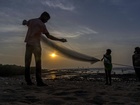
After heat records were smashed and a torrent of extreme weather events rocked countless countries in 2023, some climate scientists believed that the waning of the El Nino weather pattern could mean 2024 would be slightly cooler.
It didn't happen that way.
 Full Story
Iran has paused the process of implementing a new, stricter law on women's mandatory headscarf, or hijab, an official said — a bill that many believe could have reignited the protests that engulfed the Islamic Republic after the 2022 death of Mahsa Amini.
The controversial law, which was approved by the parliament in September 2023, will not be sent to the government as planned this week, according to one of the country's vice presidents. The development effectively means that Iran has halted enacting the legislation.
 Full Story
Real Madrid meets Mexican club Pachuca in the final of the watered-down Intercontinental Cup on Wednesday, with Kylian Mbappé expected to be available to play for the Spanish powerhouse after nursing a left-thigh injury.
The tournament — being played in a new format after FIFA expanded the Club World Cup for 2025 — brings together the champions of all six soccer confederations. It takes place every year while the bigger Club World Cup will happen every four years.
 Full Story
Bones are visible here and there among the mounds of earth in a field south of Damascus, one of the mass graves around Syria believed to hold the bodies of tens of thousands of people killed under Bashar Assad's rule. With his ouster, residents, forensic teams and international groups face what could be a yearslong task of unearthing the dead.
In this site alone, by the town of Najha, several tens of thousands of bodies could have been buried, said Stephen Rapp, a former U.S. ambassador-at-large for war crimes issues who was visiting the site Tuesday. Some are believed buried under already existing graves of a regular cemetery nearby, he said.
 Full Story
As the war in Gaza rages, Syria's government transforms, and the Israeli-occupied West Bank seethes, Armenian residents of the Old City of Jerusalem fight a different battle — one that is quieter, they say, but no less existential.
One of the oldest communities in Jerusalem, the Armenians have lived in the Old City for decades without significant friction with their neighbors, centered around a convent that acts as a welfare state.
 Full Story
The Iranian rial on Wednesday fell its lowest level in history, losing more than 10% of its value since Donald Trump won the U.S. presidential election in November and signaling new challenges for Tehran as it remains locked in the wars raging in the Middle East.
The rial traded at 777,000 rials to the dollar, traders in Tehran said, down from 703,000 rials on the day Trump won.
 Full Story
High in the mountains of the Israeli-controlled Golan Heights, the town of Majdal Shams is home to members of one of the Middle East's most insular religious minorities: the Druze.
With its roots in 10th century Ismailism, a branch of Shiite Islam, the roughly 1 million-strong minority is spread across Syria, Lebanon, Israel and the Golan Heights.
 Full Story
Israel's prime minister, Benjamin Netanyahu, entered Syrian territory Tuesday and said Israeli troops would remain in the area indefinitely, blurring the border with its northern neighbor.
Since its establishment in 1948, Israel has never had fully recognized borders. Throughout its history, the frontiers with its Arab neighbors have shifted as a result of wars, annexations, ceasefires and peace agreements.
 Full Story
